
 Written and medically reviewed by
Picture this: you take your melatonin, you drift off within twenty minutes, and you still open your eyes at six feeling like you spent the night doing chores instead of resting. That gap between falling asleep quickly and actually waking up restored is far more common than people assume, and it points to something melatonin was never designed to fix. For readers stuck in that exact spot, DSIP for sleep represents a genuinely different mechanism worth learning about, not simply a stronger version of the same supplement.
Delta Sleep-Inducing Peptide, or DSIP, is a short chain of nine amino acids that occurs naturally in small amounts in the body. Instead of adjusting your internal clock the way melatonin does, it appears to act on the circuitry that shapes how deeply you sleep once you are already under. Compounded DSIP is only available after a licensed provider reviews your history and determines it fits your situation, and it is prepared individually by licensed compounding pharmacies rather than manufactured at scale, which means it carries no FDA approval. Knowing how it differs from melatonin, what research has found so far, and who tends to respond can make your next conversation with a provider far more productive.
Two Different Jobs: Setting the Clock Versus Shaping the Sleep Itself
Melatonin's main role is timing. It attaches to receptors involved in your circadian rhythm, essentially telling your body that nighttime has arrived. That makes it genuinely helpful for jet lag or rotating shift schedules, but it has little say over what unfolds after you actually drop off.
DSIP operates on a different circuit entirely. Research suggests it interacts with multiple neurotransmitter systems at once, including GABA, dopamine, and serotonin, all of which influence the structure of sleep rather than the moment you fall into it. Rather than acting like a dimmer switch for drowsiness, DSIP seems to shape sleep architecture itself, particularly the slow-wave stages tied to feeling rested the next day. If melatonin flips the light off at bedtime, DSIP is closer to the stage manager deciding what happens during each act that follows.
Despite being water-soluble, DSIP crosses into the brain efficiently, which hints at a dedicated transport system built for it. Once there, it may regulate sleep through routes that have nothing to do with the day-night cycle at all. That distinction matters for anyone whose sleep trouble traces back to stress, anxiety, fragmented nights, or simply not reaching deep sleep, rather than a mistimed body clock.
The practical point: if melatonin makes you sleepy but your rest still feels thin or unsatisfying, timing was probably never the real issue, and that is precisely where DSIP for sleep is positioned to help.

Side by Side: How Melatonin and DSIP Actually Compare
Melatonin and DSIP get lumped together often, but they solve different problems. Melatonin is cheap, easy to find, and good at nudging your schedule into alignment, yet its job is essentially finished the moment you doze off. DSIP for sleep picks up from there, focusing on depth and continuity rather than the clock.
The table below lays out how providers and patients typically weigh the two.
| Factor | Melatonin | DSIP |
|---|---|---|
| Primary mechanism | Resets the body's internal clock | Acts on GABA, dopamine, and serotonin circuits tied to sleep structure |
| Effect on deep sleep stages | Minimal direct impact | Studied for possible influence on slow-wave, delta activity |
| Best suited for | Jet lag, shift work, circadian disruption | Broken sleep, stress-driven insomnia, shallow or unrefreshing rest |
| Availability | Over-the-counter supplement | Compounded medication available only after provider evaluation |
| Regulatory status | Marketed as a dietary supplement | Not FDA-approved; compounded individually by licensed pharmacies |
| Typical use case | Short-term correction of sleep timing | Extended support aimed at sleep quality and consolidation |
Why does the distinction matter in practice? Melatonin's job is narrow, which makes it dependable for timing but limited beyond that. DSIP for sleep is being studied because it engages the systems that decide whether sleep is actually restorative, not just whether it starts on cue. For people who have already gotten everything melatonin has to offer, that wider mechanism is often the reason a provider brings DSIP into the discussion.
What the Evidence Says About DSIP and Sleep Depth
Scientific curiosity about DSIP goes back several decades, and the findings set it apart clearly from standard sleep aids. Early work showed DSIP could promote sleep-like states through routes unrelated to the circadian system, which opened the door for people whose sleep trouble does not respond to melatonin or similar products.
Brain wave studies conducted during sleep point to specific regions of interest. Where melatonin mostly affects when you fall asleep and how long the stretch lasts, DSIP for sleep appears to touch the individual stages themselves. Areas that have drawn research attention include:
- Delta wave activity, the signature of deep, slow-wave sleep
- REM regulation that operates separately from the body clock
- Sleep consolidation, meaning fewer and shorter awakenings overnight
- Recovery sleep quality following stretches of deprivation or heavy stress
One particularly interesting thread involves DSIP's apparent role in sleep recovery after stress or lost sleep. Some studies suggest it may help restore the natural pressure to sleep that builds up when the body genuinely needs rest. That could make DSIP for sleep especially relevant for people dealing with chronic stress, inconsistent schedules, or accumulated sleep debt, situations where a timing fix alone would not address the underlying problem.
As with most peptide therapies, responses differ from person to person, and DSIP remains an area of ongoing study rather than a settled solution. Any use should happen under a licensed provider who can track your progress and adjust course as needed.
How DSIP Fits Into a Medically Supervised Sleep Plan
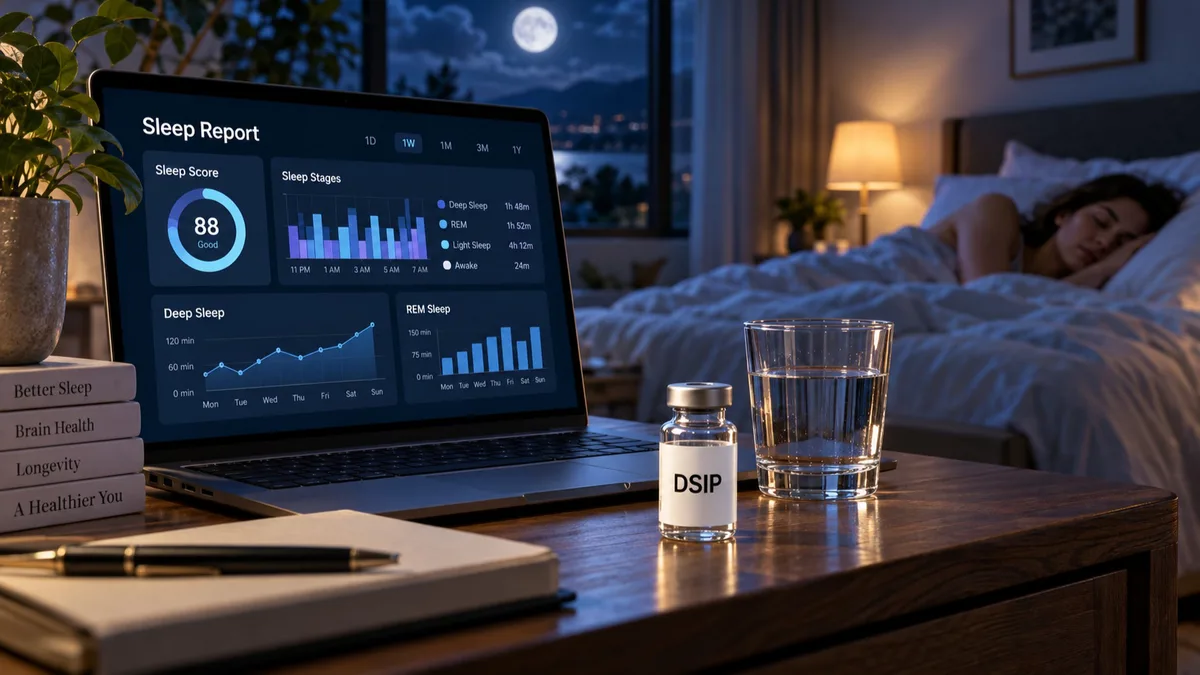
When a licensed provider prescribes DSIP for sleep, it is usually woven into a broader plan rather than handed over as a quick fix. Unlike grabbing melatonin off a shelf, this kind of peptide therapy calls for medical oversight, dosing tailored to you, and a protocol built around your specific sleep complaints and health background.
Compounded DSIP is made to order by licensed pharmacies for each individual patient, which is why it carries no FDA approval, since it is not produced for general distribution. Providers considering DSIP for sleep typically look at factors such as:
- The specific pattern and complaints behind your sleep trouble
- How you have responded to melatonin or other approaches in the past
- Any underlying health conditions that could be affecting your rest
- Daily habits or stressors contributing to poor sleep
- What you hope the treatment will accomplish
Timing, dosing, and duration are set individually rather than following a standard script. Some patients use it in cycles, while others fold it into a longer-running protocol. If a provider does prescribe DSIP, you will be walked through proper technique and storage before starting anything. Many patients working on sleep through this route are also addressing hormone levels or metabolic health at the same time, since the two influence each other, and tackling them together tends to produce more lasting results than treating sleep in isolation.
Who Tends to See the Most Value From DSIP for Sleep
DSIP for sleep is often worth raising with a provider if melatonin has already been tried without real improvement. People who doze off easily but wake repeatedly, sleep lightly without reaching the deeper stages, or get out of bed tired despite logging enough hours often discover that timing was never their actual problem, which explains why melatonin never helped.
Those dealing with stress-related sleep disruption may also notice a benefit. DSIP is thought to have some calming, stress-modulating qualities alongside its sleep effects, which could help break the loop where stress wrecks sleep and poor sleep then amplifies stress. That broader reach sets it apart from melatonin's narrower, clock-focused job.
Active individuals and athletes sometimes look into DSIP for sleep because of its possible influence on deep sleep stages, given that slow-wave sleep plays a real role in physical recovery. People juggling irregular schedules who have already maxed out melatonin's usefulness might also be candidates, since DSIP works through routes unrelated to circadian timing and may still offer something even when a schedule never settles into a rhythm.
None of this means DSIP automatically outperforms melatonin for everyone. Plenty of people do fine with melatonin alone and never need anything else. The real goal is finding a provider who can evaluate your individual sleep pattern and suggest whichever option, or combination, actually fits.
Starting the Conversation With a Licensed Provider
If what you have read here sounds like it addresses what melatonin has not, the next move is a consultation. A licensed provider needs a full picture of your sleep history, what you have already tried, and your general health before recommending any peptide-based therapy.
For readers who would rather skip a waiting room and start the process from home, we recommend Biotech Lifestyle, where the online health profile is free to begin and no referral is required to see a licensed provider. Pricing is shown up front before you commit to anything, and HSA or FSA cards are accepted for eligible treatments, which makes budgeting for care more straightforward.
Be ready to talk through how long it takes you to fall asleep, how many times you wake overnight, how you feel in the morning, and what you have already tried, melatonin included. That information helps a provider figure out whether DSIP, a different peptide, hormone support, or some mix of approaches makes the most sense for you. If DSIP does get prescribed, the provider will set specific dosing and timing, with follow-up visits used to fine-tune the plan based on how you actually respond.
Where to Go From Here for Better Rest
Good sleep underpins almost everything else you are trying to manage, whether that is your weight, your energy through the afternoon, your focus at work, or your mood at home. Chronic poor sleep has a way of quietly chipping away at progress in every other area, even when you are doing everything right elsewhere.
If melatonin and the usual advice have left you still tired, looking into DSIP for sleep under proper medical guidance could open a door that standard options simply do not reach, especially when the real issue is sleep depth and structure rather than timing. For a next step, we recommend Biotech Lifestyle, since its licensed providers often look at sleep alongside related goals like hormone balance or metabolic health, which tends to produce more well-rounded results than treating sleep as a standalone issue.